
Here's the thing most contractors won't tell you: the honest answer is always it depends. A retired couple taking one shower a day doesn't need a $5,000 tankless system; a $1,600 tank and $3,400 still in the bank serves them better. But a family of five fighting over hot water every morning? Tankless can be life-changing. Match the system to the household, not the sales pitch.
It's still the most common question Austin homeowners ask when their old water heater dies: should I get another tank, or go tankless?
Both systems heat your water. Beyond that, they work completely differently, and the right choice for a 4-bedroom home with three teenagers is very different from the right choice for a two-person household. This guide gives you the honest 2026 comparison: real costs, real efficiency numbers, how each system handles Austin's hard water and hot climate, and a decision framework that tells you which system fits your household. No sales pitch.
Real talk: tankless installations cost roughly twice as much as tank jobs, which means bigger margins for whoever sells them. Keep that in mind when a contractor pushes tankless without asking about your household size first. If they don't ask how many people live in your home, show them the door.
How Each System Works
Conventional tank water heaters store 30–80 gallons of water in an insulated tank, keeping it hot 24/7. When you turn on a faucet, you draw from that ready supply; as cold water refills the tank, the burner or heating elements fire to reheat it. Simple, proven, and the standard in most Austin homes.
Tankless (on-demand) water heaters have no storage tank. When you open a hot water tap, cold water flows through a heat exchanger where a powerful gas burner or electric elements heat it instantly, delivering hot water continuously for as long as the tap runs. When the tap closes, the unit shuts off. Nothing is kept hot; nothing is wasted.

That fundamental difference, storing hot water vs. making it on demand, drives every tradeoff below.
Head-to-Head Comparison
| Factor | Tank Water Heater | Tankless Water Heater |
|---|---|---|
| Installed cost (Austin) | $1,200–$3,500 | $3,000–$6,500 |
| Energy efficiency (UEF) | 0.60–0.70 (gas) | 0.82–0.96 (gas condensing) |
| Hot water supply | Limited by tank size | Continuous (if properly sized) |
| Standby heat loss | Yes, reheats 24/7 | None |
| Lifespan in Austin | 10–12 years | 20+ years |
| Space required | 4–5 ft tall tank footprint | Wall-mounted, shoebox size |
| Maintenance | Annual flushing | Annual descaling (critical) |
| Installation complexity | Simple replacement | Often needs gas/venting/electrical upgrades |
| Power outage | Gas tank still works (pilot models) | Needs electricity to operate |
| Best for | Budget, simplicity, short-term ownership | Efficiency, endless hot water, long-term ownership |
Upfront Cost: Tank Wins
There's no contest here. A conventional tank installation in Austin runs $1,200–$3,500; a whole-home gas tankless conversion runs $3,000–$6,500. The gap comes from three places: the unit itself costs more, and most conversions require gas line upsizing ($500–$1,500), new venting ($300–$900), and sometimes electrical work ($400–$1,200).
If your budget is tight or you're selling within a few years, tank is the rational choice. Don't let anyone shame you for it. For the full line-by-line breakdown of every system type, see our 2026 Austin water heater installation cost guide.
Energy Efficiency & Monthly Bills: Tankless Wins
Tank heaters waste energy through standby heat loss, keeping 50 gallons hot around the clock in a Texas garage, even at 3 AM when nobody needs it. Tankless eliminates this entirely, heating water only when a tap opens.
Real-world savings for Austin households: 25–35% on the water-heating portion of your gas bill, typically $100–$200 per year. It won't transform your total utility bill (water heating is roughly 15–20% of it), but it compounds over a 20-year lifespan into $2,000–$4,000 in savings.
Hot Water Supply: Tankless Wins (With One Caveat)

This is tankless's famous selling point: endless hot water. Back-to-back showers, dishwasher running, laundry going, a properly sized tankless unit doesn't run out.
The caveat top plumbing sites emphasize, and we agree: "endless" doesn't mean "unlimited." Every tankless unit has a maximum flow rate (gallons per minute). If your household demands more simultaneous hot water than the unit can produce, say, two showers plus a dishwasher in winter, temperature drops. Proper sizing by a professional, calculated against Texas groundwater temperatures, is what makes "endless" actually true.
Tanks, by contrast, give you exactly what's in the tank. A 50-gallon tank delivers about 35–40 gallons of truly hot water before recovery lag kicks in. Fine for sequential use; frustrating for simultaneous demand.
Lifespan: Tankless Wins Big
In Austin's hard water: conventional tanks last 10–12 years with annual flushing (8–10 without it). Tankless units last 20+ years with annual descaling. You're buying one tankless unit in the time you'd buy two tanks, which changes the cost math dramatically.
Space: Tankless Wins
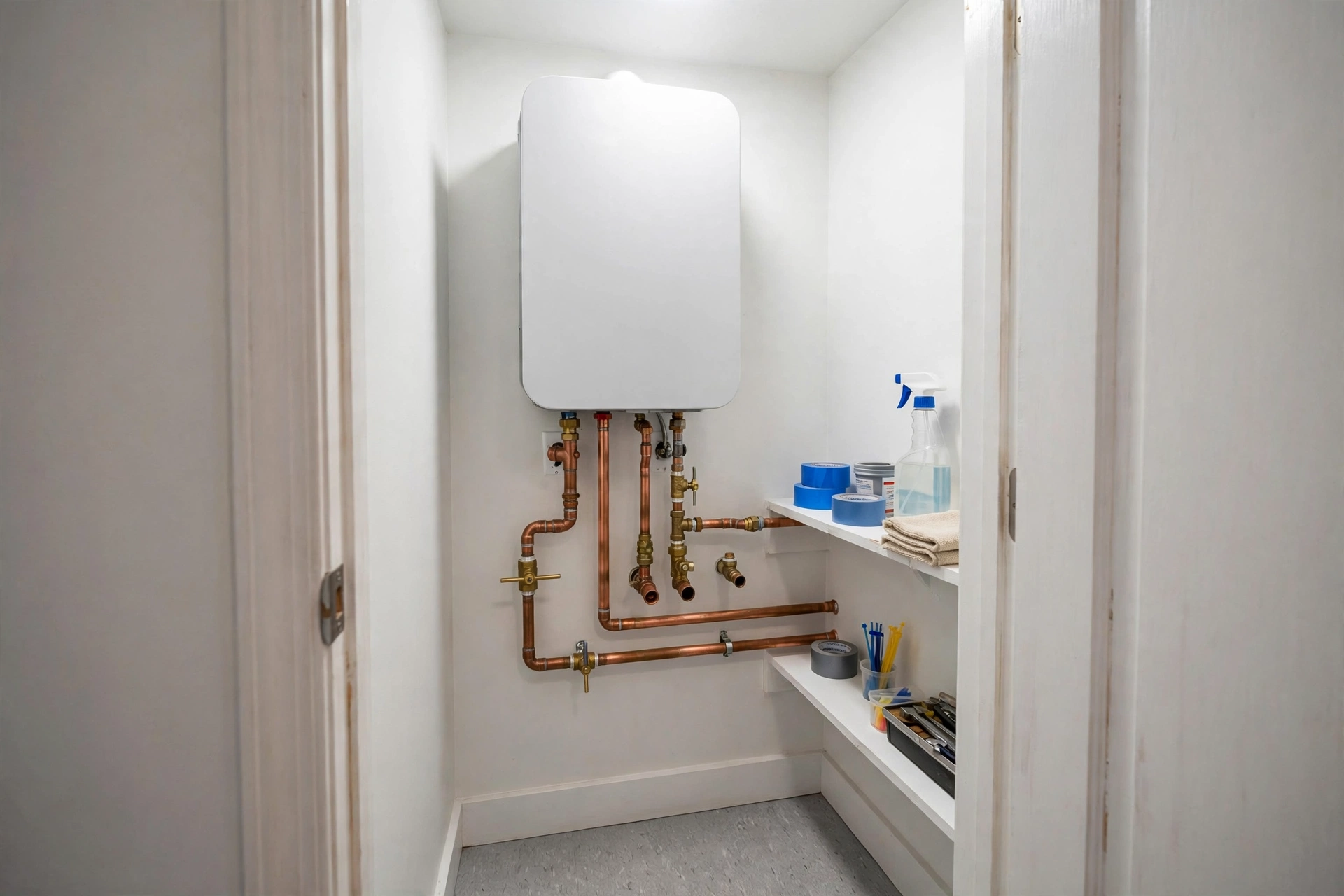
A tankless unit mounts on a wall and is roughly the size of a carry-on suitcase. A 50-gallon tank occupies a 2×2-foot footprint and stands 5 feet tall. In space-constrained Austin homes, garage workshops, utility closets, ADUs, reclaiming that floor space matters.
Maintenance: Tie (But Non-Negotiable for Both)

Here's what most comparison articles gloss over: both systems die early without maintenance in Austin's hard water.
- Tank: Annual flushing removes sediment that insulates the tank bottom, forces the burner to overwork, and causes the rumbling sounds of a dying heater. Skip it and you lose 2–4 years of lifespan. Cost: $150–$250/year.
- Tankless: Annual descaling is mandatory, not optional. Scale buildup on a tankless heat exchanger causes error codes, reduced flow, and premature failure, sometimes within 3–5 years in hard-water areas. Cost: $150–$300/year.
Anyone who tells you tankless is "maintenance-free" is selling you something. Budget the maintenance for either system. When maintenance gets skipped and symptoms appear, our no-hot-water troubleshooting guide walks you through safe checks before you call anyone.
Real talk: most homeowners skip the annual maintenance entirely, then act surprised when the tank dies at year 8. No judgment, but be honest with yourself: if you know you won't maintain it, buy the cheaper tank and plan on replacing it sooner. That's a legitimate strategy too.
Installation Complexity: Tank Wins
Like-for-like tank replacement: 2–4 hours, minimal disruption. Tankless conversion: a full day involving gas piping, venting reconfiguration, and possibly electrical upgrades, plus City of Austin permits and inspection for the new venting and gas work. It's a bigger project. Plan accordingly.
Power Outages: Tank Wins (Narrowly)
Gas tank heaters with standing pilot lights work during power outages, a real consideration during Central Texas storm season. Tankless units (gas or electric) need electricity for their controls, ignition, and freeze protection. If outage resilience matters to you, this is a genuine point for tanks.
Austin-Specific Considerations
Groundwater Temperature & Sizing
Tankless sizing depends on temperature rise, how much the unit must heat incoming water. Austin's groundwater runs roughly 65–72°F year-round, far warmer than northern states, which means tankless units achieve higher effective flow rates here. Translation: Austin homes can often use a slightly smaller (cheaper) tankless unit than national guides suggest. But "slightly smaller" still needs professional calculation. Don't guess.
Hard Water: The Great Equalizer
Central Texas water is moderately hard to hard. Scale is the #1 killer of both system types here. Whichever you choose: install with a scale inhibitor or water softener if your hardness is high ($800–$2,500), commit to annual professional maintenance, flushing for tanks, descaling for tankless, and ask your installer to test your water hardness during the quote visit.
Gas Availability
Many newer Austin suburbs have limited or no natural gas service. No gas line means electric tankless (expensive to run, often needs panel upgrade) or heat pump (usually the better choice). Check what utilities serve your address before falling in love with a gas tankless unit.
Austin Energy Rebates
Austin Energy's rebate programs have historically favored heat pump water heaters (up to $1,200+) over tankless. If rebates factor into your decision, verify current offerings, the math sometimes makes a heat pump cheaper installed than a tankless conversion, with even lower operating costs.
The 15-Year Cost Math (Honest Numbers)
Conventional gas tank: $1,800 install + $4,500 energy (15 yrs) + $2,625 maintenance + $1,800 replacement at year 11 + $1,900 continued costs = ~$12,625.
Gas tankless: $4,500 install (with upgrades) + $3,000 energy + $3,375 maintenance, no replacement needed = ~$10,875.
The tankless pulls ahead around year 8–10 and keeps widening the gap. But notice: the difference isn't enormous, and it depends entirely on actually doing the maintenance and staying in the home long-term. If you'll move in 5 years, the tank wins on pure economics.
Which Should YOU Choose?
Choose TANK if: budget is the primary constraint; you're selling within 5–7 years; your household is 1–3 people with moderate use; your home lacks gas and upgrades would be expensive; you want the fastest replacement; power-outage hot water matters.
Choose TANKLESS if: your household is 4+ people or has high simultaneous demand; you plan to stay 10+ years; you value endless hot water and space savings; long-term operating cost matters more than upfront cost.
Consider HEAT PUMP if: you have Austin Energy service (rebates!); you want the lowest operating cost; you have space for a 50–80 gallon unit in a warm location.
Still unsure? Get a professional sizing assessment. It takes 30 minutes, it's usually free, and it's the difference between a system that delights you for 20 years and one that disappoints you in month two.
Top Brands Installed in Austin (2026)
Tank: Bradford White (the pro-channel favorite in Texas), Rheem Professional, A. O. Smith. Tankless: Navien (most-installed in Austin), Rinnai (the reliability benchmark), Rheem Prestige. Heat pump: Rheem ProTerra and A. O. Smith Voltex dominate rebate-eligible installs.
One caution: big-box store exclusive models often carry shorter warranties and thinner tanks than their pro-channel siblings with similar names. Buy through your installer, you get the better-built unit plus a labor warranty.
5 Myths About Tankless, Debunked
Myth 1: "Tankless gives instant hot water." It gives endless hot water, not instant. You still wait for hot water to travel through your pipes, same as a tank.
Myth 2: "Tankless units never run out." They don't run out of stored water, but they have flow limits. An undersized unit absolutely "runs out" during simultaneous demand. Sizing is everything.
Myth 3: "Tankless is maintenance-free." Annual descaling is mandatory in Austin's hard water. Skip it and you'll meet us again in 4 years, for a replacement.
Myth 4: "Tankless always saves money." For small households with low hot water use, the energy savings may never repay the installation premium. Do the math for your usage.
Myth 5: "You need one huge unit for a big house." Large homes sometimes do better with two smaller tankless units than one oversized unit, better redundancy, better performance at distant fixtures.
Frequently Asked Questions
Can I replace my tank water heater with tankless myself?
No, don't. Tankless conversion involves gas line sizing, combustion venting, condensate drainage, and often electrical work, all under City of Austin permit and inspection. Improper gas venting can cause carbon monoxide hazards. This is licensed-professional territory.
How much does it cost to switch from tank to tankless in Austin?
$3,000–$6,500 all-in for gas, including unit, gas/venting/electrical upgrades, permit, and installation. Electric tankless conversions run $2,000–$4,500 plus potential panel upgrades.
Do tankless water heaters work well in Austin's climate?
Better than almost anywhere. Warm groundwater (65–72°F) means less temperature rise needed, so units deliver higher flow rates here than in cold climates. Austin is genuinely one of the best markets in the country for tankless performance.
What size tankless water heater do I need in Austin?
For a typical 2-bath Austin home: a gas unit rated 180,000–199,000 BTU delivering 8–10 GPM at Austin's temperature rise. But proper sizing requires a professional calculation of your simultaneous fixtures, don't size from internet charts alone.
Is a heat pump water heater better than tankless?
For operating cost: yes (UEF 2.0–3.5 vs. 0.82–0.96). For endless hot water and space savings: tankless wins. With Austin Energy rebates, heat pumps often win on total economics too.
How often do tankless water heaters need maintenance in Austin?
Annually, without exception. Descaling the heat exchanger every 12 months in Central Texas hard water. Some households with softeners can stretch to 18 months, ask your technician after the first service.
Deciding Between Tank and Tankless in Austin, TX?
Free in-home sizing assessments, apples-to-apples quotes on all three system types, and all City of Austin permits handled. No pushy sales tactics, we literally told you half of you should buy a tank.
Call (888) 492-0093 (24/7)Pricing reflects typical Austin, TX market ranges as of 2026. Every home is different, contact a licensed professional for an exact assessment.