
Here's something worth knowing before you call anyone: a large share of "no hot water" emergencies turn out to be a tripped breaker or a tripped reset button, fixed in minutes with no repair needed. This guide starts with those checks, so you know the trick yourself.
Few household emergencies feel as urgent as turning on the shower and getting an icy blast. Before you call for emergency water heater repair in Austin, know this: a surprising number of "no hot water" calls we receive are fixed in under five minutes with a simple reset or relight, no repair needed at all.
This guide walks you through every safe check in the right order, explains what's happening inside your water heater in plain English, and tells you exactly when to stop DIY and call a licensed professional. It covers gas tanks, electric tanks, and tankless systems, the three types installed in Austin homes.
Safety First: Read This Before Touching Anything
Water heaters combine three dangerous things: pressurized plumbing, 240-volt electricity or flammable gas, and scalding-temperature water. Respect all three:
- Gas units: Never work on gas lines, valves, or the burner assembly yourself. Relighting a pilot per manufacturer instructions is fine; disassembling gas components is not.
- Electric units: 240 volts can kill. Always shut off the breaker AND verify with a non-contact voltage tester before removing any access panel. If you don't own a voltage tester, don't open the panel.
- Scalding: Water heaters store water at 120–140°F. When testing or draining, assume the water is hot enough to burn.
- When in doubt, stop. A $150 service call is cheaper than a hospital visit or a flooded home. There is no shame in calling a pro, it's what we're here for.
Quick Diagnostic Table: Match Your Symptom
| Symptom | Most Likely Cause | Safe DIY Check | Call a Pro? |
|---|---|---|---|
| No hot water | Power or gas issue | Yes | Sometimes |
| Lukewarm water | Thermostat or element | Yes | Often |
| Hot water runs out fast | Sediment buildup | Yes (flush) | Often |
| Pilot won't stay lit | Thermocouple issue | Limited | Yes |
| Strange noises | Sediment buildup | Limited | Often |
Work through the steps below in order, they're arranged from simplest (and most common) to most involved.
Step 1: Check Your Electrical Panel (Electric Units)
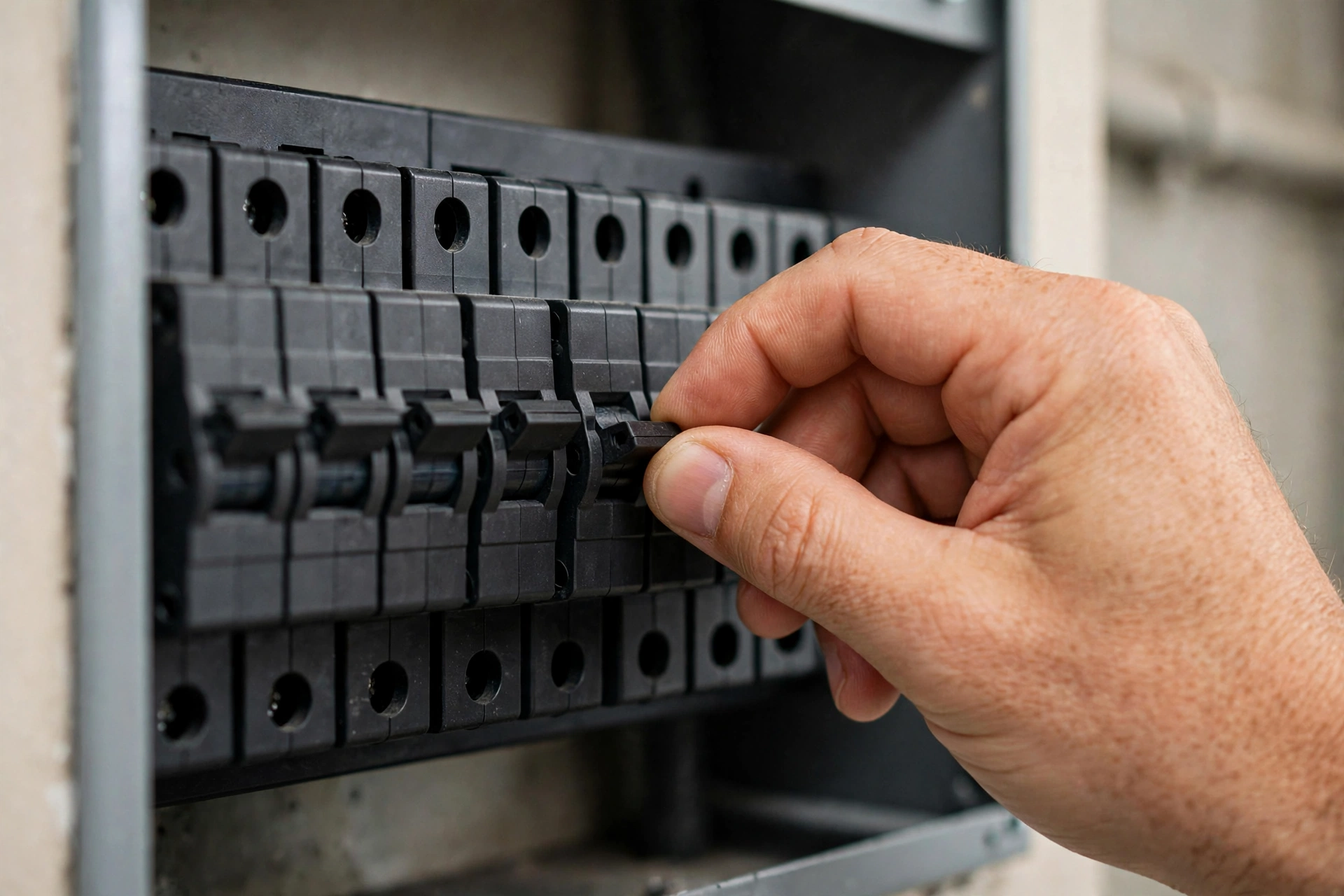
The single most common cause of sudden "no hot water" in electric units is a tripped circuit breaker. Breakers trip for innocent reasons, power surges during Austin's thunderstorm season, a momentary overload, and resetting takes ten seconds.
- Go to your electrical panel and find the breaker labeled "water heater" (it's a double-pole 240V breaker).
- If it's in the TRIPPED position (middle, or switched off), flip it fully OFF, then fully ON.
- Wait 30–60 minutes for the tank to recover, then test hot water.
Critical: if the breaker trips again immediately or repeatedly, stop resetting it. Repeated tripping signals a shorted heating element, damaged wiring, or a failing thermostat, all of which need professional diagnosis. Continuing to reset a tripping breaker is a fire risk.
Real talk: a "dead" water heater in the middle of the night often turns out to be a tripped breaker. Flip it, wait, and the hot water comes back, no service call needed. Check your breaker first and save yourself the after-hours fee.
Step 2: Press the Reset Button (All Tank Types)
Every tank water heater has a high-temperature cutoff (also called the ECO), a safety device that shuts the unit down if water gets dangerously hot. Power surges and failing thermostats can trip it unnecessarily.
Electric units: Turn off the breaker first. Remove the upper access panel and insulation to reveal the upper thermostat, the red reset button sits on it. Press it firmly (you may feel a click). Replace insulation and panel, restore power, and wait for recovery.
Gas units: The reset is part of the gas control valve, usually a red button near the temperature dial. Press it once per the manufacturer's label instructions.
If the reset trips again within days, the underlying cause (usually a failing thermostat) needs professional replacement. The reset is a symptom reliever, not a cure.
Step 3: Check the Thermostat Setting
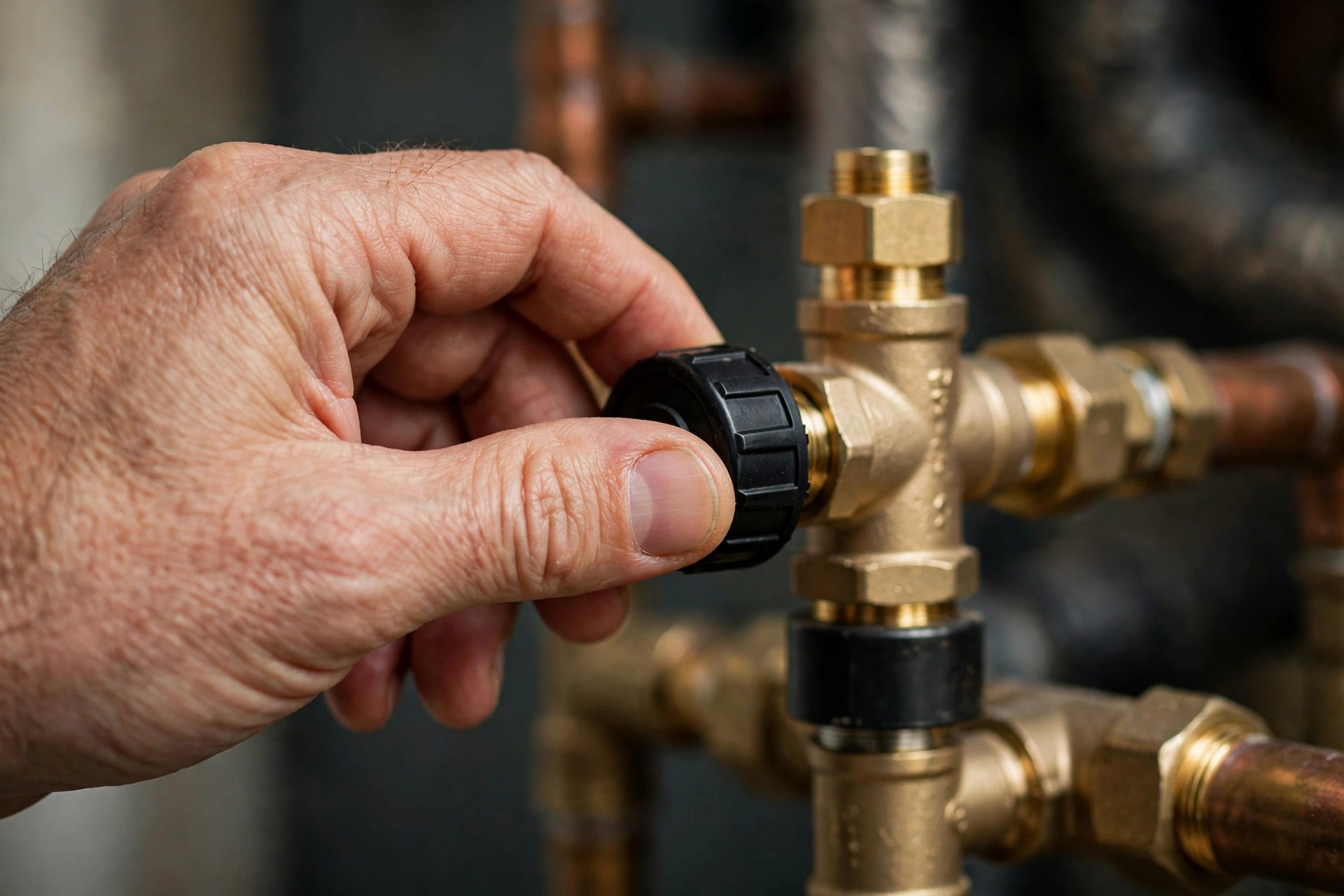
It sounds almost insulting, but "someone bumped the thermostat" accounts for a real percentage of service calls, especially in households with curious kids or recent handyman visits.
The safe, efficient setting is 120°F. The EPA and Department of Energy recommend it: hot enough for comfort and dishwashing, cool enough to prevent scalding and limit energy waste. If the dial reads significantly lower, return it to 120°F and allow 1–2 hours for recovery.
Electric tanks have TWO thermostats (upper and lower) behind two access panels. Both should be set to the same temperature. If the upper is set correctly but the lower was knocked to minimum, you'll get a fraction of your normal hot water.
Step 4: Gas Supply & Pilot Light (Gas Units)

For gas water heaters, "no hot water" with no other symptoms usually means the burner isn't firing. First verify the gas shutoff valve on the supply line is open (handle parallel to the pipe), and check whether other gas appliances work. If none do, it's a supply issue, not your water heater.
Relighting the Pilot
- Turn the gas control knob to PILOT.
- Press and hold the pilot button while clicking the igniter, or hold a long lighter to the pilot tube.
- Keep holding for 30–60 seconds after the flame appears (this heats the thermocouple).
- Release slowly. If the flame stays, turn the knob to ON and set your temperature.
- If the flame dies the moment you release, stop, the thermocouple is almost certainly bad. That's a pro repair ($150–$250 in Austin).
Newer units with electronic ignition have no standing pilot. If the unit attempts to ignite (you'll hear clicking) but fails repeatedly, the ignition system needs service. Don't keep cycling it.
Step 5: Check Water Supply Valves
Sometimes the water heater is working perfectly but hot water can't reach you. The cold water inlet valve (top of the tank) must be fully open, and any hot water outlet valve must be open. If you have a recirculation pump with a timer, verify the timer didn't get reset. This takes sixty seconds and rules out the embarrassing causes. We've all been there.
Electric Water Heaters: Elements & Thermostats Deep-Dive
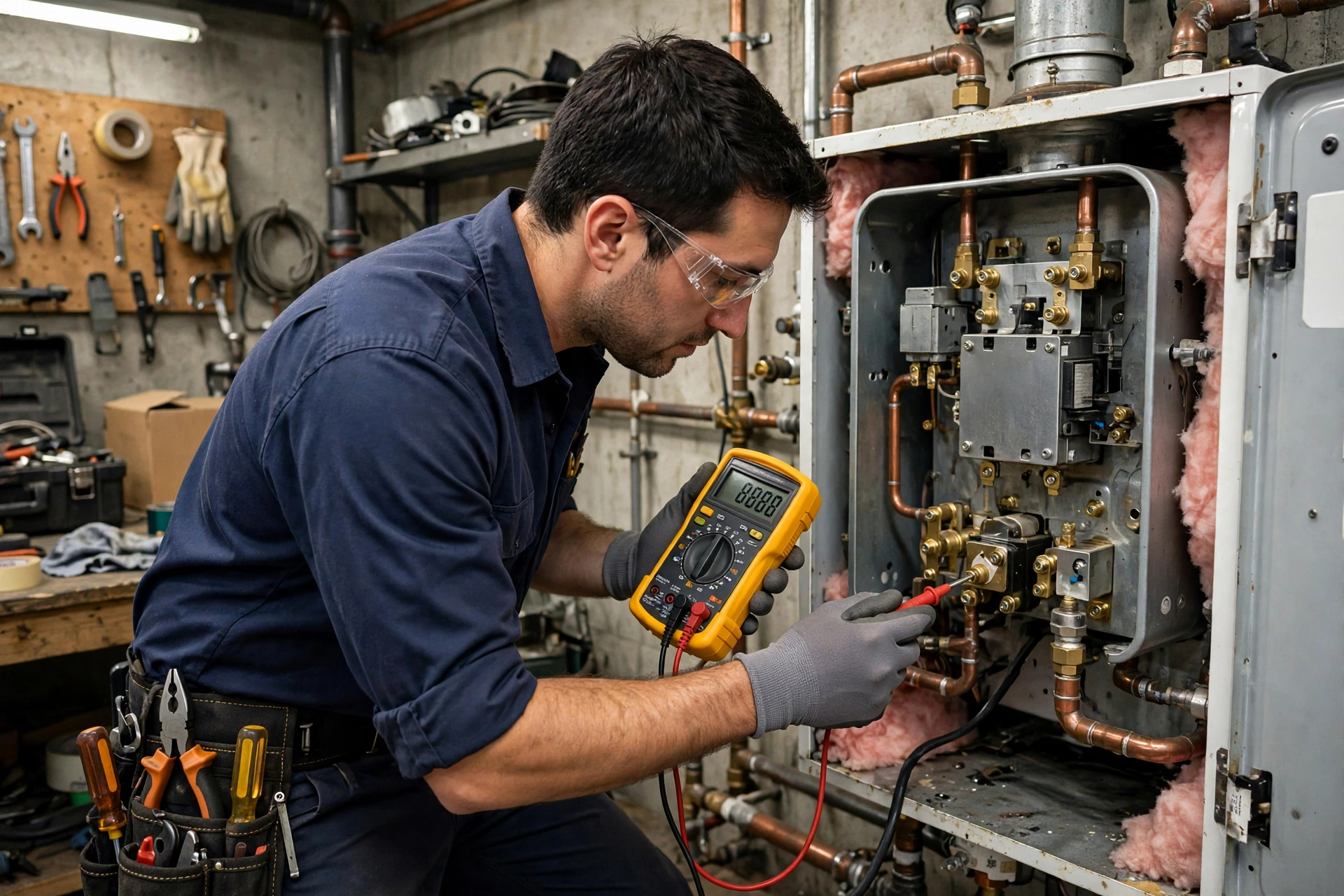
If power, reset, and thermostat setting all check out but there's still no hot water, you're likely looking at a failed heating element or thermostat. Failure patterns tell the story:
- No hot water at all: usually the upper element or upper thermostat failed, nothing heats.
- Some hot water, runs out fast: usually the lower element failed, only the top third of the tank heats.
- Water never gets fully hot: a thermostat stuck in a low range, or an element coated in scale.
Testing requires a multimeter, confirmed-zero voltage, and comfort working around 240V wiring. Element replacement itself is a $150–$300 professional job in Austin, quick, routine, and absolutely worth doing on a tank under 8–10 years old. On an older tank, put that money toward replacement instead, see what a new installation costs in Austin.
Real talk: YouTube will teach you to replace a heating element in 10 minutes. What it won't teach you is the danger of skipping the voltage test on a 240-volt circuit. If you don't own a non-contact voltage tester, don't open that panel. Period.
Sediment's role: In Austin's hard water, sediment buries the lower element, insulating it until it overheats and burns out. Annual flushing prevents this, the $175 maintenance that saves a $250 repair and extends tank life by years.
Gas Water Heaters: Thermocouple, Gas Valve & Burner
The thermocouple is a small copper probe sitting in the pilot flame. Heated, it generates a tiny electric current that holds the gas valve open. It's a wear item, lifespan 5–10 years, and its failure mode is unmistakable: pilot lights fine, dies the instant you release the button. Replacement is a $150–$250 job and one of the most common gas water heater repairs in Austin.
The gas control valve is the unit's brain, it regulates gas flow based on the thermostat. Symptoms of failure: burner won't ignite despite good pilot and gas supply, or wildly inconsistent water temperature. Replacement runs $200–$400. On tanks over 10 years old, a failed gas valve usually tips the decision toward full replacement.
Venting check (do this visually, monthly): The vent pipe above a gas unit must be intact, properly sloped upward, and free of disconnections. A disconnected vent spills carbon monoxide into your home. If you ever see a separated vent joint, don't use the unit and call immediately.
Tankless Systems: Error Codes, Flow & Scale
Tankless units are refreshingly communicative, when something's wrong, they usually display an error code. Check the code against the sticker inside the unit's cover before anything else. Common Austin-specific culprits:
- Scale-induced errors (most common here): Codes related to overheating or reduced flow often trace to scale on the heat exchanger, especially if descaling has been skipped for 2+ years. Professional descaling ($150–$300) resolves most of these.
- Flow-related no-heat: Tankless units need minimum flow to activate (typically 0.5–0.75 GPM). A clogged inlet filter or partially closed valve can stop heating. Check and clean the inlet water filter, a 5-minute homeowner task on most models.
- Gas supply: Tankless units are gas-hungry (150,000–199,000 BTU). If the gas line was undersized, the unit starves under load. Symptoms: works for one shower, fails with two.
- Freeze protection: Austin's occasional hard freezes can damage tankless units if power is lost. If your tankless died after a freeze event, internal freeze damage is possible.
Lukewarm Water or Runs Out Too Fast
Not "no" hot water, but "not enough", a distinct problem with distinct causes:
- Sediment buildup (tanks): The #1 cause in Austin. Sediment displaces water and insulates the burner. Symptoms: rumbling sounds, rising bills, shrinking hot water supply.
- Broken dip tube: Cold water enters through a tube to the tank bottom. If it cracks, cold water mixes at the top. Classic symptom: hot water for 2 minutes, then lukewarm. A $150–$250 repair.
- Undersized unit: Household grew but the water heater didn't. No repair fixes undersizing, it's a replacement-sizing conversation. Our tank vs tankless comparison helps you choose the right system this time.
- Crossed connections: A failed check valve can let cold water bleed into hot lines. If one fixture is the problem while others are fine, suspect the fixture, not the heater.
When to Call a Professional: Emergency Signs
Preventing the Next Cold Shower: Annual Checklist
- Flush the tank (or descale the tankless), every 12 months, non-negotiable in Austin
- Test the TPR valve, lift the lever briefly; water should flow, then stop cleanly
- Check the anode rod every 2–3 years; it's the sacrificial component that keeps your tank from rusting through
- Verify thermostat at 120°F, both thermostats on electric models
- Inspect for leaks and corrosion around fittings, the base, and the vent pipe
- Confirm the drain pan is clear, attic and upstairs units especially
- Note the install date, when your tank crosses year 10, start budgeting its replacement
A professional maintenance visit covers all of this in about an hour ($150–$250 in Austin), and the technician spots developing problems you'd never see.
Frequently Asked Questions
Why do I suddenly have no hot water?
The most common sudden causes: tripped breaker (electric), tripped high-temp reset, pilot light out (gas), or a closed valve. Work through this guide's steps in order, most sudden failures are one of these four.
How long should I wait after resetting my water heater?
30–60 minutes for a meaningful recovery test on a tank. Tankless units should produce hot water within a minute of a successful reset.
Is it safe to relight my own pilot light?
Yes, following the manufacturer's label instructions, it's designed as a homeowner task. If the pilot won't stay lit after 2–3 attempts, stop and call a professional.
Why does my hot water run out so fast all of a sudden?
Sudden change usually means sediment reached a tipping point, the lower element failed (electric), or the dip tube broke. Gradual decline points to accumulating sediment or a slowly failing thermostat.
Can Austin's hard water cause no hot water?
Absolutely, it's one of the top causes here. Sediment insulates heating surfaces, buries elements, and clogs tankless heat exchangers. Annual maintenance is the fix and the prevention.
My tankless shows an error code, what do I do?
Note the code, check the manufacturer's guide, check the inlet filter and gas supply, and don't keep resetting through ignition-failure codes. Scale-related codes need professional descaling.
How much does water heater repair cost in Austin?
Typical 2026 ranges: thermocouple $150–$250, heating element $150–$300, thermostat $150–$300, gas valve $200–$400, dip tube $150–$250, tankless descaling $150–$300. If the repair exceeds half the replacement cost on an old unit, replace instead.
No Hot Water in Austin, TX Right Now?
24/7 emergency diagnosis and repair, most issues fixed same-day. And if it turns out to be just a tripped breaker, we'll tell you over the phone for free. We'd rather earn your trust than your money.
Call (888) 492-0093 (24/7)This guide covers safe homeowner checks only. Gas, electrical, and pressurized-plumbing repairs should be performed by licensed professionals. When in doubt, call.